Most people walk into Central Park thinking they already know what they’re going to see. A fountain. Some trees. Maybe a hot dog from a cart near the path. And then they walk out two hours later having seen maybe 10 percent of what the park actually holds, which, honestly, is kind of a shame.
Here’s the thing. Central Park has been crowned America’s top tourist attraction by Travel + Leisure magazine, drawing over 42 million visitors every year. Forty-two million. And a solid chunk of them never make it past the southern end. So if the goal is to actually see the park, not just pass through it, this guide is worth reading before the trip, not during.
Quick-Reference: Central Park Attractions by Interest
Attraction | Best For | Location in Park |
Bethesda Terrace & Fountain | Art, architecture, film history | Midpark, 72nd St |
Strawberry Fields | Music history, cultural meaning | West side, 72nd St |
Belvedere Castle | Views, history, natural science | Midpark, 79th St |
The Ramble | Nature, birding, quiet exploration | Midpark woodland |
Bow Bridge | Scenic walks, photography | West of the Ramble |
The Mall & Literary Walk | Arts, literature, sculpture | Midpark promenade |
Cleopatra’s Needle | Ancient history, education | East side, 81st St |
Conservatory Garden | Formal gardens, off-the-beaten-path | Northeast, 105th St |
Central Park Zoo | Families, school groups | Southeast corner |
Sheep Meadow | Group rest, picnics, people-watching | West side, 66–69th St |
#1 Bethesda Terrace and Fountain
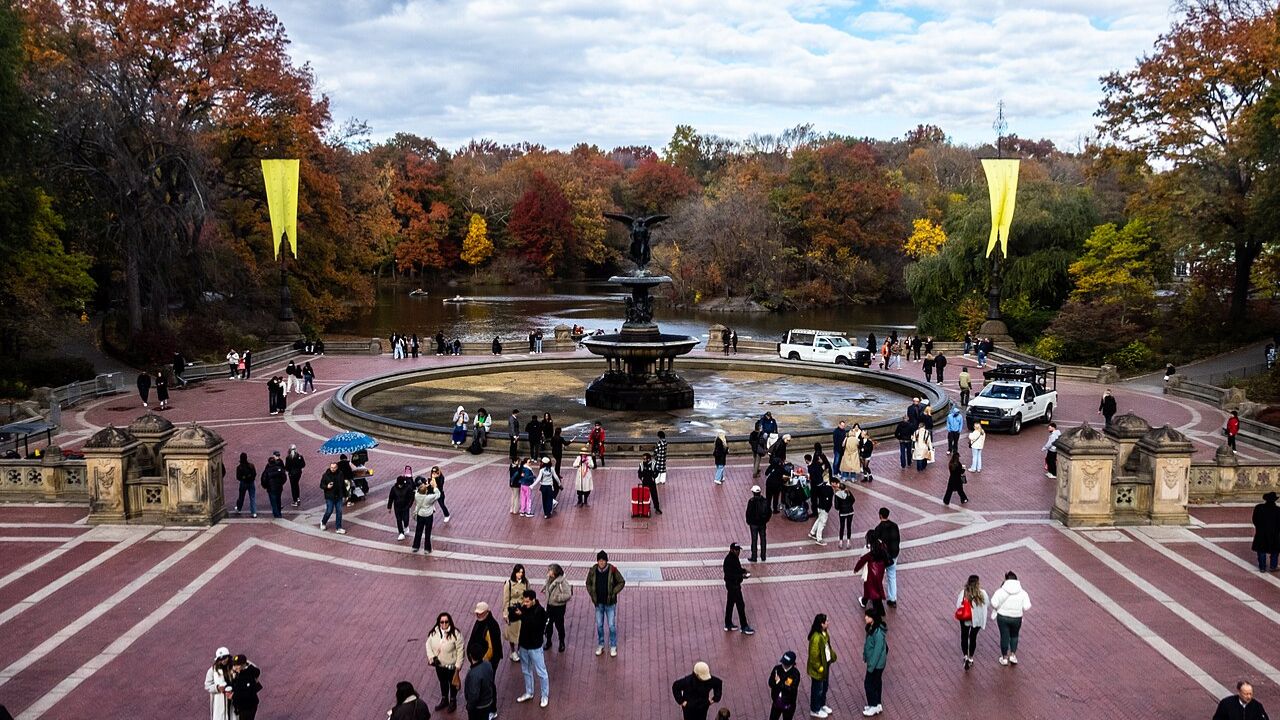
There are a handful of spots in New York that hit differently in person than they do in photos. Bethesda Terrace is one of them.
At the very center of the park lies Bethesda Terrace, a beloved spot for visitors and movie fans alike, featured in films like Elf, Enchanted, The Avengers, and dozens of others. The terrace boasts an expansive two-level design with the magnificent Bethesda Fountain and the heavily ornamented Arcade.
The Angel of the Waters statue sitting at the top of that fountain? It was the only sculpture commissioned as part of Central Park’s original design. One. That’s not trivia, that’s context; and it changes how the whole space feels when you’re standing in it. For any group focused on arts or American history, this isn’t a photo stop. It’s a conversation starter.
Groups visiting New York with an arts focus will find that Central Park pairs naturally with e.e. Tours’ New York Art Tours, which are built around exactly this kind of layered cultural experience.
And on any given afternoon, there’s usually a soul singer performing under the arcade, which is either beautiful or surreal depending on your mood. Either way, it works.
#2 Strawberry Fields
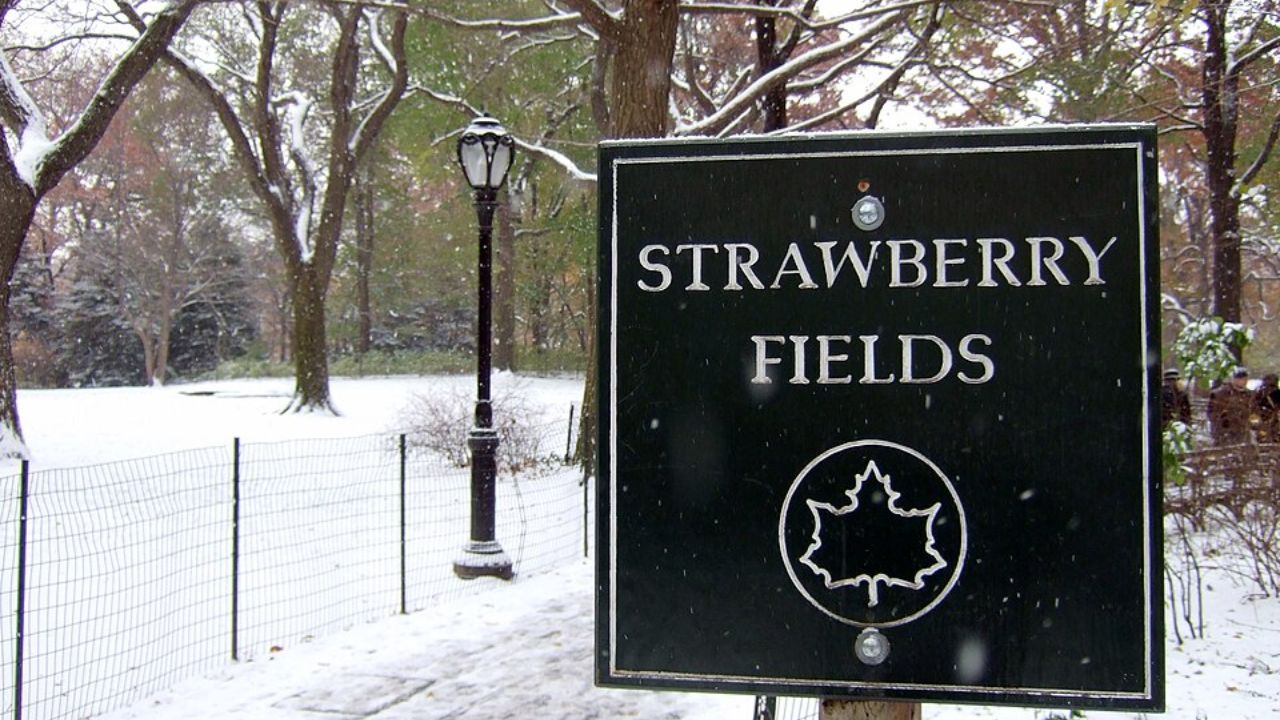
Walk west from Bethesda, and you’ll find it. No dramatic signage, no ticket booth. Just a circular mosaic in the ground that says Imagine and people standing around it in near-silence.
John Lennon lived just across the street from the park and often strolled its paths. Now visitors from around the world flock to Strawberry Fields to pay tribute to Lennon and admire the famous Imagine mosaic and the International Garden of Peace.
What’s striking is the mood of the place. People genuinely get quiet here. It’s the kind of stop that works for music history buffs, sure, but also for anyone interested in what public memorials actually do; why certain spaces hold meaning the way they do. That’s a surprisingly rich discussion for a group.
For groups with a deeper interest in New York’s musical legacy, e.e. Tours’ New York Music Tours build on moments exactly like this one.
#3 Belvedere Castle
The name sounds dramatic. The structure itself is a bit smaller than people imagine (which is always a fun moment). But what it does give you is one of the best views in the entire park.
Take in a sweeping view of the Great Lawn, the Ramble, and Turtle Pond from Belvedere Castle, a folly built on one of the highest points in the park. You can also grab a discovery kit from inside the castle, which includes binoculars, a map, and a guide for bird-watching in the Ramble’s woods.
But here’s the part most visitors miss: Belvedere Castle also contains exhibit rooms and has served as the location of the official Central Park weather station. A Victorian-era “castle” that doubles as a functioning weather monitoring station. Very New York energy, actually.
For educational groups especially, this spot opens up conversation about how the park was designed, why a folly on a hill was part of the original plan and what Frederick Law Olmsted and Calvert Vaux were thinking when they drew it up.
#4 The Ramble
And they shouldn’t. This is genuinely one of the best things to do in Central Park if the group wants something that doesn’t feel like tourism.
Thirty-six acres of winding trails, rocks, and streams remain here, seemingly waiting to be discovered. Everything visible is man-made, dating back to 1859; even the waterfalls can be turned on and off. Which is kind of wild when you think about it.
Central Park is known for great bird-watching opportunities, and the Ramble is one of the prime locations. The park hosts more than 210 species of birds, some of which make their homes here full-time, and others that migrate via the incredible Atlantic Flyway.
For groups that include younger students, there’s something genuinely memorable about standing in what feels like actual woods in the middle of Manhattan. It resets the whole experience.
#5 Bow Bridge
From the picturesque Bow Bridge to the powerful symbolism of Strawberry Fields, these two stops pair naturally together on a walking route, and Bow Bridge is the kind of spot that doesn’t need much explanation.
It’s a cast-iron bridge from 1862, one of the oldest in the park, stretching across the Lake. Bow Bridge is known as one of the best places in Central Park for anyone who enjoys a good view. Whether taking a quiet walk or snapping pictures, it offers a backdrop that’s hard to beat.
The light hits it differently depending on the season. Morning visits especially.
#6 The Mall and Literary Walk
The Mall stretches a quarter-mile through the heart of Central Park, creating one of the city’s most elegant tree-lined promenades.
But what makes it particularly interesting for arts and literature-focused groups is the southern end: the Literary Walk, where bronze statues of Shakespeare, Robert Burns, and other writers stand among the elms. It’s an outdoor sculpture gallery that most people walk past without realizing what they’re looking at.
For groups traveling with any educational intent, students studying literature, art, or American cultural history, this section of the park is genuinely useful. Not just “nice to see.” Actually useful.
#7 Cleopatra’s Needle
People are surprised by this one every time, which is probably why it’s worth including.
Known as the oldest outdoor monument in New York City, the Obelisk was built around 1425 BCE in Heliopolis, Egypt.
1425 BCE. Standing behind the Metropolitan Museum of Art, a few steps from the park path, casually existing alongside joggers and tourists. There’s no line, no ticket, no guided presentation. Just a 3,500-year-old artifact in the open air. For history-focused trips, this stop alone tends to generate more genuine conversation than an hour in a museum.
It’s the kind of moment that fits perfectly within a structured New York History Tour, where the goal is to make the past feel real rather than just readable.
#8 Conservatory Garden
The Conservatory Garden features a French-style North Garden, an Italianate Center Garden, and an English-style South Garden. It sits in the northeast corner of the park near 105th Street, which is probably why most people never make it there.
It’s a quiet place that feels like stepping into a different world; you wouldn’t think you’re right in the middle of NYC.
And honestly, that’s the appeal. Groups who want a photo stop that doesn’t look like everyone else’s Central Park photos? This is it. Tucked away, formally designed, genuinely beautiful.
#9 Central Park Zoo
The Central Park Zoo features penguins, snow leopards, red pandas, and a tropical rainforest exhibit within its smaller footprint. The adjacent Tisch Children’s Zoo allows younger kids to interact with goats, sheep, and other friendly animals.
It’s compact, which is actually a feature, not a limitation. Groups move through it easily, it doesn’t eat half a day, and it sits right at the southeast corner of the park near Fifth Avenue. A solid addition to any itinerary with younger students or mixed-age groups.
#10 Sheep Meadow
No landmarks. No statue. Just 15 acres of open lawn where New Yorkers come to be normal humans for a while.
Sheep Meadow is a local favorite for picnicking, sunbathing, and people-watching. Sheep actually grazed there early in the park’s history; hence the name, to keep the grass manicured.
For groups, this is the built-in break. The lunch stop, the debrief moment, the space where people talk about what they just saw. Every good itinerary has a place like this. Sheep Meadow is that place.
The Real Argument for a Guided Tour
Here’s what gets lost when groups visit Central Park without structure: the story behind everything they’re looking at. Bethesda Fountain becomes “the fountain from that movie.” Cleopatra’s Needle becomes “some tall stone thing.” The Literary Walk becomes a nice shaded path.
At 843 acres, Central Park is too big for most people to see in one day on foot, and without context, even the parts people do see don’t land the way they should. A guided experience changes that completely. The fountain became a study in post-Civil War public art.
The obelisk becomes a conversation about cultural exchange spanning three millennia. The park’s entire design becomes a lesson in what democratic public space was meant to look like in 19th-century America.
That’s the difference between a visit and an experience. And for groups coming to New York with any educational or arts focus, that difference is the whole point.
And if the group is still figuring out what kind of New York experience fits best, requesting a quote takes about two minutes and opens up a conversation with someone who’s built hundreds of these itineraries.
FAQs
What are the most popular things to do in Central Park?
Visitors often explore Bethesda Terrace, Bow Bridge, Belvedere Castle, Strawberry Fields, and the Central Park Zoo. These landmarks represent some of the park’s most famous attractions.
How long does it take to explore Central Park?
A quick visit may take two to three hours, but exploring major attractions comfortably can take half a day or more.
Is Central Park free to enter?
Yes. Central Park is open to the public and free to enter year-round.
Are guided tours available in Central Park?
Yes. Several tour companies offer walking tours that highlight the park’s history, architecture, and famous filming locations.